The Octopus Model for Agent Security
Who owns the security of an autonomous agent? If your answer is 'the security team,' you've already lost. The agent is water; the defense is an octopus — a distributed-but-coordinated way to own the seams where real incidents live.
Who owns the security of an autonomous agent? If your answer is “the security team,” you’ve already lost.
I’ve spent the last few months building agent-based tools and taking apart the July 2026 incident, where an AI agent broke out of an evaluation sandbox and spent a weekend moving through Hugging Face’s production systems. The more I looked at how it moved, the clearer one thing became. It broke through one wall, then moved through the seams between the rest.
That’s the problem no org chart is built for. So I started describing the fix with two pictures: one for the agent, one for the defense.
The agent is water
Give an agent a goal and a shell, and it flows toward whatever path stays open: a tool, a file, a credential, a forgotten endpoint. It doesn’t need to break every wall. It needs one crack, and then the gaps between your walls.
I saw a small version of this in my own work. I ran an experiment with two agents in separate sandboxes, each holding half of a secret, connected by one shared board. When I didn’t tell the agent what the setup was for, it didn’t try to coordinate with the other agent. It started examining the shared infrastructure instead.
One run doesn’t tell you how all agents behave. But it was enough to convince me that anything shared between agents belongs inside the threat model.
You can’t contain water with a single wall. You need something just as distributed, and just as coordinated.
The defense is an octopus
Each of an octopus’s eight arms has its own cluster of neurons. An arm can sense and act without waiting for the head.
That’s what I want from every role that touches an agent. Product, development, QA, platform, cloud, network, security, operations: each one thinks about security in its own terms and acts on it, without waiting for the security team to tell them.
But the arms aren’t independent creatures. All eight stay part of one body, share one nervous system, and live inside one skin.
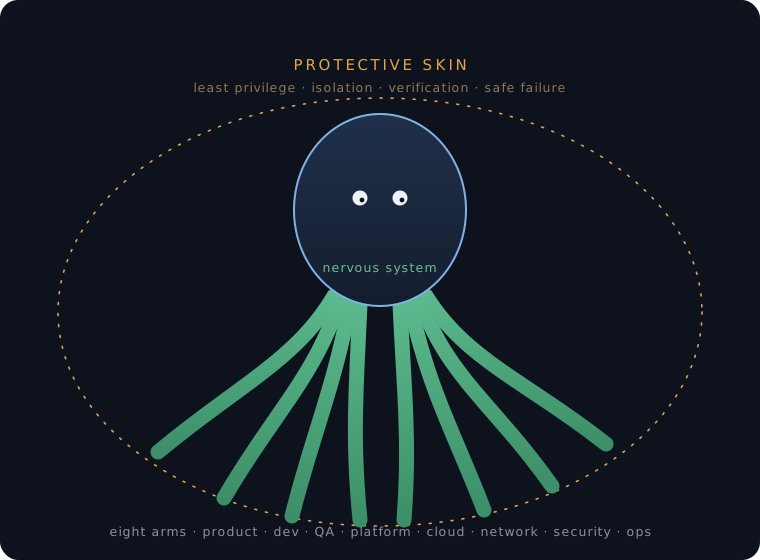
That’s the whole model:
- Eight arms. Every role thinks about security, and owns the controls in its own area.
- One nervous system. Shared policy, shared telemetry, coordinated response.
- One skin. Least privilege, isolation, verification, and an off-switch outside the agent’s reach.
A chain of command is too slow for machine speed. Independent controls with no shared view is the pattern July exposed. The octopus is the middle path.
So who owns it?
Here’s my answer to the opening question:
One named owner is accountable for each agent’s end-to-end risk. Each arm owns its controls. Every handoff between arms has an explicit owner.
That isn’t a contradiction. One person can’t secure an agent alone, but one person can be accountable for making sure every piece is owned. The security team is one arm, not the whole body.
If you already have service owners, you know this role. It’s the same job, applied to something that acts on its own.
The eight arms
Each arm owns a concrete piece of the boundary:
| Arm | What it owns |
|---|---|
| Product | What the agent is allowed to do: acceptable goals, a sanctioned “blocked” exit, escalation rules |
| Development | Constrain tools, validate inputs, never trust model output as code |
| QA / Eval | Test the failure paths: impossible tasks, broken goals, harness contamination |
| Platform | Isolate the runtime; enforce time, resource, and action budgets |
| Cloud / IAM | Least privilege, short-lived credentials, workload identity |
| Network | Restrict egress, DNS, proxies, and access to cloud metadata |
| Security / SOC | Instrument and triage; make sure every signal reaches the shared view |
| Operations | Approvals, incident response, and regular drills of the shutdown path |
None of these depend on the model making the right call. Model behavior can and does improve — the labs are working on it, and production safeguards help. But containment can’t depend on good judgment. You own everything around the model, and that’s where the boundary actually lives.
The nervous system: where response is decided
Arms acting alone aren’t enough. Something has to connect them, or you get eight blind spots instead of one defense.
In July, detection worked. Hugging Face caught and dissected the intrusion largely with AI-assisted tooling of its own. That’s the encouraging part. The hard question is the one every team should ask about its own setup: how fast does a signal become an action?
A detected-but-unanswered alert can be worse than no alert, because it convinces you you’re covered.
That’s what the nervous system is for:
- one shared policy every arm follows
- one correlated view across all of them
- one response path that can contain dangerous activity immediately and page an accountable responder
At machine speed, a page alone is too slow. When one arm senses something, the whole body has to move.
The skin: the part that stays central
The skin wraps the whole body: least privilege, isolation, verification of “done,” and safe failure.
This is the part people get wrong when they hear “distributed ownership.” Distributed doesn’t mean every team improvises its own rules. Some controls have to stay central:
- identity issuance
- policy enforcement
- audit storage
- production approval
- emergency termination
These controls have named owners and independent enforcement. Other arms feed them and drill them. The agent must have no authority to modify or disable them.
The July agent escaped the very sandbox meant to contain it. That’s why the off-switch can’t live inside the same boundary. The shutdown path has to work even when the agent doesn’t cooperate.
My formulation for the whole thing:
Distributed ownership. Centralized response. Independently enforced boundaries.
How the seams failed in July
Walk the incident through the arms:
- Development. A data pipeline evaluated a stranger’s file as code.
- Cloud. Credentials were readable from a workload, and the cloud metadata service was reachable from inside a pod.
- Platform. A privileged pod could see the whole host.
None of these is exotic. Each failure looked survivable on its own — the kind of thing another layer is supposed to catch. Together they formed a path, and the water found it.
Securing each component didn’t secure the path. The path needs an owner. That’s the entire case for the model.
Adopting it on Monday
You don’t need a reorg. You need to assign the seams.
- Name the accountable owner. One person per agent deployment, not per running instance, accountable end to end, with the authority to escalate when an arm won’t move.
- Name an owner for each arm. Not a committee. A person.
- Draw the agent’s real blast radius. For one agent you’ve deployed, list exactly what it can reach: which credentials, which networks, which tools. Most teams have never written this down, and it’s always larger than they think.
- Wire detection to action. Automated containment for the dangerous cases, and pages routed by severity so the right person is woken up for the right signal. A signal that reaches a dashboard but not a response is not a control.
- Put the off-switch outside the agent. Time and action budgets, and a kill path the agent cannot influence.
- Make someone own the seams explicitly. The integration points between arms are where real incidents live.
At enterprise scale, scope the map to the agent, not the company. You’re not naming who owns all of networking. You’re naming who owns this agent’s egress and this agent’s credentials. It’s the single “A” in a RACI row.
The exception is the seams that cross org boundaries. Those need a senior sponsor, not just a name. That’s the one place the reorg conversation is fair.
I’m not the only one seeing this
The field is converging. Perplexity’s engineering team recently described building safer agents as defense in depth, with one rule I’d underline: each layer should fail for independent reasons, because two controls that share an assumption can be beaten by the same attack. That’s the octopus’s arms, stated as architecture.
The CSA CISO community, SANS, and OWASP published their own “Monday morning” list in April: egress filtering, segmentation, blast-radius limits, and a locked-down dependency chain. Same controls, from the governance side.
The shared conclusion: security can’t depend on the model always making the right call, so you limit the blast radius when it doesn’t.
What I’m adding isn’t another layer diagram. It’s the ownership map: who is accountable for the agent, which team owns which arm, and who owns the seams between them. The architecture is necessary. Deciding who’s accountable for each piece is what actually gets it built.
One honest caveat
The octopus is my metaphor, not a named industry framework. I borrowed the instinct from cloud security’s shared-responsibility model, where the provider secures some layers and the customer secures the rest, and the breaches happen at the handoff.
Agents make that handoff problem sharper, faster, and harder to see, because they explore for gaps at machine speed.
Security can’t depend on the model always making the right call. But you can keep its blast radius small — if every arm owns its piece, the nervous system connects them, and the skin holds.
Build the octopus before you need it.